
Most Recent Newsletters
My oldest is in 2nd grade now, and after years of play-testing games with me, he has pretty high standards for new games. So I can say this with full confidence: He loves all these games, and I expect your kids will, too!
I've been working my way through all my old recommendations to find the best games for any age, so you can check out my previous editions of this newsletter at the links below.
So let's check out these 2nd grade games!
I have to be honest, I am loving this tour back through my old newsletters. There are so many games I forgot and have rediscovered through this process!
If you're curious, you can find my recommendations for Pre-School and Kindergarten as well. To be honest, most of these games are capable of scaling up or down to fit kids of different age levels. That's why they're so good! So check those games out as well if you haven't already.
And now, on to first grade!

Last week, I shared the best math games that you can play with your pre-schooler. This week, let's take a look at kindergarten games!
It happened so slowly.
In the fall of 2017, I sent my very first Games for Young Minds newsletter. I had set up a website to act as an archive of my old newsletters, and each week I added a new post.
And the archive got longer, and longer, and longer...
Now I have over 100 games in my archive with no clear way to navigate them! I am thinking about how to fix that, but in the meantime I figured the least I could do is collect some of my favorite games and toys for each grade level.
This week, I'll share some recommendations for pre-schoolers. Each subsequent week, I'll cover the next grade until we hit middle school!

Man, do I love a game that cleans up easily.
Some of my favorite games are an absolute pain to clean up. Like Ticket to Ride with its hundreds of cards, or Blokus where you've ruined the game the moment you misplace a single piece.
Also, space is becoming a premium at the Haines household. I'm not saying that I have a problem, but our game collection has officially conquered two linen closets and a bookcase in the dining room. I can quit anytime though, I swear.
Point being, small games are very exciting to me right now.
So when I put out a call for game ideas on twitter last month, I tried to pick up some of the smallest games I could find (and a couple that were big but sounded awesome).
That's how I found Qwixx.

After 3+ years of writing newsletters, sometimes I find myself at a loss.
I pace around my house, complaining out loud about how I can't possibly find any more cool math stuff, I've written about everything already, time to pack it in and start my Philadelphia 76ers fanblog.
And then I pass my bookshelf, where I see a book I've had for a half-decade and somehow managed not to write about yet.
How does this happen??
Anyway, I am extremely excited to share with you one of my longstanding favorite resources, both as a teacher and as a parent of a very artistic daughter.
It's called This is Not a Math Book.

I have a (not so) secret: at least half the games I recommend, I found out about on Twitter.
I've used Twitter as a way to learn about math, teaching, and games for almost a decade now, and it's still my favorite place to get new ideas for math games, fun puzzles, and great classroom activities.
Yes, Twitter is an awful website that is probably bad for our society, but my little section over here with the games is really fun.
Today's recommendation came to me from Heidi Fessenden, who is a math coach and teacher in Massachusetts. Heidi has shared a ton of fun stuff with me over the years, so when she told me about this game I ordered it immediately.
The game is called The Genius Square.

I have TWO awesome announcements to make this week!
First of all, my friend Kyle DeBoer has started a fantastic Instagram account, @ofmathandmeeples. I am already really impressed with the way he is using the account to share math games ideas - definitely give him a follow.
I also have a great card game for parents and teachers that my kids have really been enjoying. I like the game because it scales up to a group of any size, and older kids can find more inventive solutions as their mathematical sophistication grows.
It's called Proof!

Little kids love playing with calculators.
My toddler Dalia, for example, loves nothing more than grabbing my calculators, along with anything else with buttons, and mashing them to see what happens. Adorably, she refers to her collection of button-based toys as "my growmups," as in "Daddy, these is my growmups"
My older kids like plying with them too, though. My eight-year-old is always trying to figure out what each button does, while my five-year-old tries to type in massive numbers and then say them out loud, proudly and incorrectly.
I was reminded of this by Michael Pershan, who gave me two great recommendations: First, get a big calculator with fun buttons and keep it in the car. You never know what discoveries your kids might make on the way to school!
Secondly, grab a laptop and get them to play Bad Calculators.

Have I told you about my awesome colleague Tami? She and I teach the math courses at UAB for future elementary educators. And, unlike me, she actually has years of firsthand experience teaching young children all about math.
In fact, Tami is the inspiration behind this entire newsletter. Way back in 2016 I was talking to her about finding opportunities for parents and kids to talk about math at home and she said “Yeah, but parents don’t really know how to ask good math questions. That’s why I always used to send math games home for homework. Kids love games, and parents can pick up on the rules quickly. Then the math just sort of happens.”
And an idea was born…
Last winter, Tami lent me a game that she used to use in her 1st grade classroom and then March happened and, well, I still have it. I think it’s one of the simplest, most fun early math games I’ve played - and if you don’t have the board, you can play for free with a few dice and some paper!
The game is called Knock-Out.

I'm always on the hunt for games that teach kids about the other areas of math aside from arithmetic. I can name two dozen games offhand that help kids with addition, subtraction, and multiplication, but some of the other areas of math, such as measurement, don't come up explicitly in games quite as often.
That's not to say that kids never measure in games: They do it all the time! But sometimes you want a game that helps kids think about measuring more explicitly.
Fortunately, my math teacher friend Kyle DeBoer has invented a fantastic measurement game. I took the game into my other math teacher friend, Rebecca Smith's 4th grade classroom at my son's school, and I can tell you that kids love this game!
It's called Battle Lines.
Latest Video
New to the site?
Check out some of our favorite recommendations below!
Free Games
Some of my favorite games of all time are games you can play with simple household materials. Got a pair of scissors and some paper? You can play the Fold and Cut Challenge! Got a messy playroom or junk drawer? Play a couple of rounds of Attribute Train! Have a bunch of old LEGO bricks lying around? Try to build something while blindfolded!
If you have pencil and paper handy, you and your kids can play a classic game such as Dots and Boxes, or you can opt for a classic-in-the-making such as Ultimate Tic-Tac-Toe. In every case, you'll have a chance to talk about all sorts of math ideas that these games provoke.
Board Games
If you're brand new to Games for Young Minds, a nice place to start are my Holiday Gift Guides from 2017 and 2018. In each guide, I list a couple games that are appropriate for each age level, as well as my reason for including them in the list.
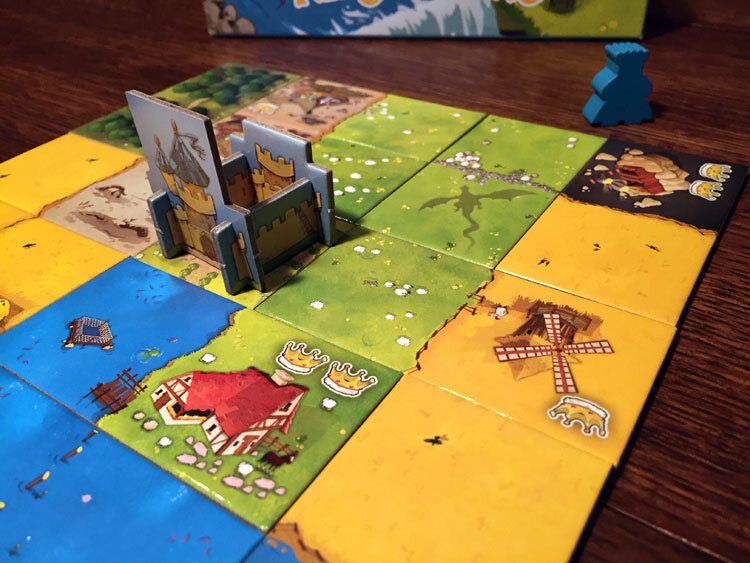
If you want to figure out how to make popular games such as Tenzi or Connect 4 more mathematical, I've got you covered. If you're interested in two-player games that weave together multiple math concepts, you could check out Patchwork or Kingdomino. If you want to play a math game that involves math concepts aside from number, you could try Blokus, Manifold, or SET.
It feels like 3rd grade is where the rubber meets the road for a lot of kids. We all remember the brutal timed multiplication tests that were foisted on us as kids, and we'd rather our own kids not feel stressed about learning that vital mathematical concept.
These games, hopefully, will give your kids a chance to think and strategize about multiplication in a way that helps them build true fluency, not just speed. And I've included a couple of non-multiplication games that are also great for 3rd graders to play.
You can always check out my recommendations for earlier ages at these links:
Pre-School
Kindergarten
First Grade
Second Grade
Now, on to 3rd grade!